
Los Angeles Commercial Roofing for Apartments, Churches, HOAs and Businesses
Our Integrity is Our Promise
Commercial Roofing in Los Angeles From a Family-Owned Contractor
Guardian Roofs handles commercial roofing in Los Angeles for apartment owners, HOA boards, churches, care facilities and businesses. We are a family-owned company that has been roofing Southern California buildings since 1984, from our Los Angeles office on Fisk Lane in Redondo Beach.
Every commercial roofing contractor in Los Angeles should be easy to verify. We hold California contractor license #847279 in the B1 general building and C39 roofing classifications. We are also a GAF Master Elite and an Owens Corning Platinum Preferred contractor, which are each manufacturer’s top contractor tier. On a commercial job that matters for a practical reason: those programs let us register qualifying roof systems for manufacturer warranty coverage, on top of our own workmanship warranty.
Recent Work: Re-Roofing Malibu City Hall After the January 2025 Fires
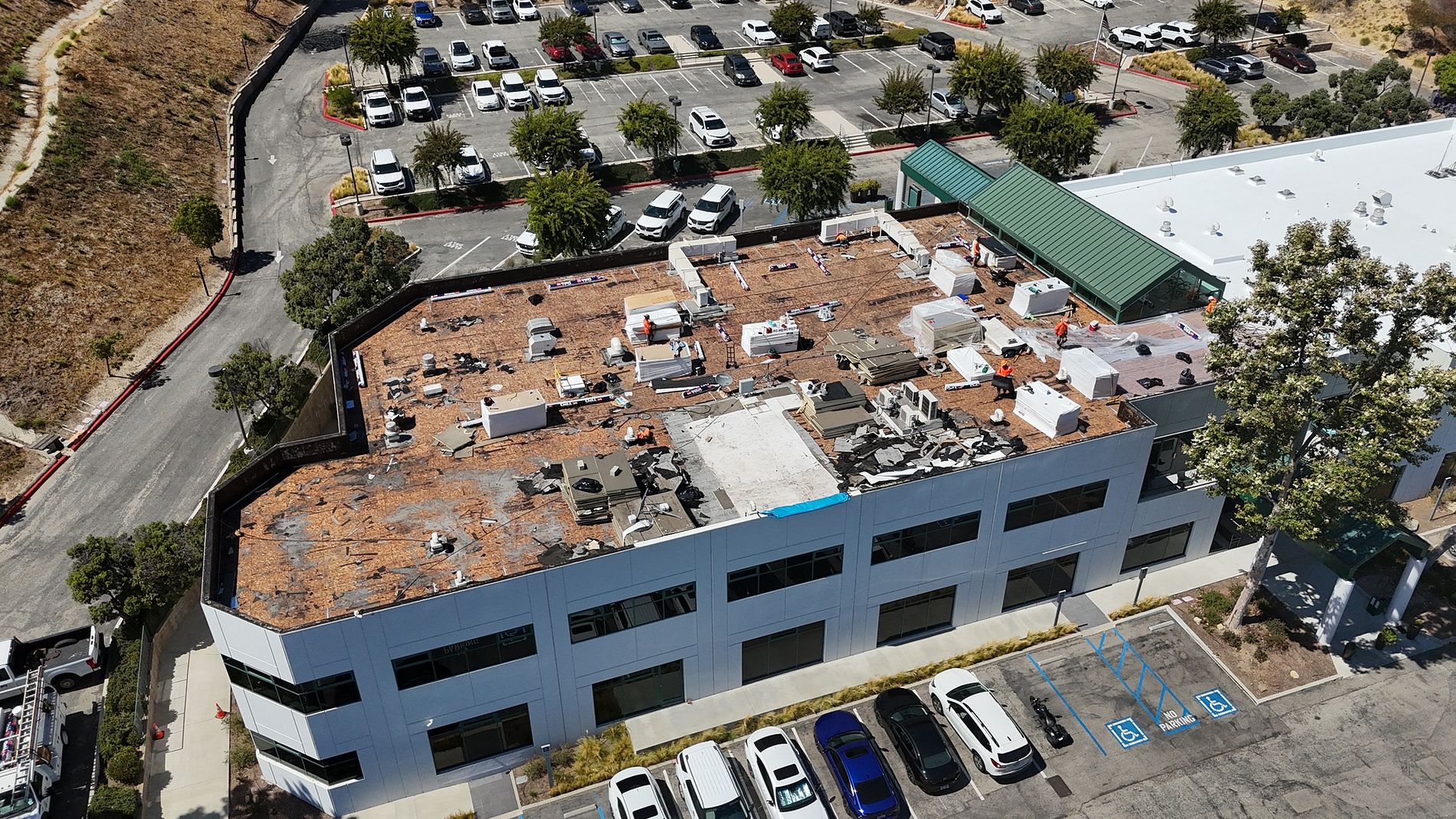
When the January 2025 wildfires swept through western Los Angeles County, wind-driven embers damaged the roof of Malibu City Hall. Once the winter rains arrived, water worked its way between the roof layers and collected there, putting the building’s interior and the city’s daily work at risk.
Our crew started by mapping where the water was trapped, then pumped and drained it out through the existing roof drains before any tear-off, so moisture stayed out of occupied offices and city staff kept working. We removed the old system down to the plywood deck and installed a new 60-mil GAF EverGuard TPO membrane over tapered polyiso insulation that slopes water toward the drains, fixing the ponding that caused the problem. The project finished on time and within budget, and you can read how we re-roofed Malibu City Hall after the fires in more detail.

Title 24 and Permit Rules for a Commercial Re-Roof in Los Angeles
Most commercial re-roofs in Los Angeles trigger two sets of rules: California’s Energy Code and the building department that issues your permit. We check both on every estimate.
California’s cool roof rule for low-slope commercial roofs
Under the 2025 California Energy Code, in effect since January 1, 2026, a low-slope re-roof on a nonresidential building generally needs a cool roof product. The Cool Roof Rating Council’s summary of the 2025 Energy Code explains the Section 141.0(b)2B trigger: more than 50 percent of the roof, or more than 2,000 square feet, whichever is less, being replaced, recovered or recoated. The product then needs an aged solar reflectance of at least 0.63 and a thermal emittance of 0.75, or a Solar Reflectance Index of 75.
The main exceptions are added roof insulation (which allows a lower reflectance), heavy assemblies of at least 25 pounds per square foot such as pavers or ballast, and roof area covered by building-integrated solar. The full standards are on the California Energy Commission’s 2025 standards page.
Apartment buildings follow their own section
Low-slope apartment roofs follow the same 0.63 rule, but steep-slope apartment roofs only need a cool product in certain climate zones. Los Angeles spans three on the Energy Commission’s climate zone list: coastal Redondo Beach, Torrance, Santa Monica and Long Beach are Zone 6, inland Compton, Downey and Cerritos are Zone 8, and downtown, Burbank and Pasadena are Zone 9. A shingle or tile apartment roof in Zones 8 and 9 generally needs a cool-rated product, while the same building in Zone 6 does not.
Who issues the permit
Inside the City of Los Angeles, the Department of Building and Safety’s express permit bulletin lets many re-roofs skip plan check when the new Class A or B covering weighs under 6 pounds per square foot, requires a Class A roof in Very High Fire Hazard Severity Zones, and points nonresidential projects to the Title 24 rule above.
Residential buildings also fall under the city’s residential cool roof ordinance when more than half the roof is replaced, so we confirm with LADBS how it applies to each apartment or mixed-use building.
At final inspection, the contractor signs the city’s Re-Roofing Certificate of Compliance, and we take care of that paperwork.
Cities such as Torrance, Long Beach and Burbank run their own building departments, and unincorporated areas go through LA County Public Works. We pull the permit with whichever office covers your address.
Recover or tear off?
A recover can save money, but the code limits it. The county’s reroofing manual allows it only over one existing layer, on a sound deck, when the old roof is not water-soaked. A roof with trapped water, like Malibu City Hall’s, has to come off.
How Los Angeles Weather Wears Down Flat and Low-Slope Roofs
Los Angeles does not get much rain, but it gets it all at once. NOAA’s 1991-2020 climate normals for the downtown USC station show about 14.25 inches a year, with roughly two-thirds falling from December through February and barely a tenth of an inch all summer. That pattern is hard on low-slope roofs in three ways:
- Ponding: a flat roof with low spots or clogged drains can sit dry for months, then hold standing water through a week of winter storms and find every weak seam.
- Sun and heat: long, dry summers bake asphalt-based roofs, which is why reflective membranes and coatings pay off inland.
- Santa Ana winds: the National Weather Service notes these dry offshore winds are most common from September through May. Gusts pull at loose perimeter metal and flashing and carry embers during fire season.
Late spring through early fall is the easiest window for a tear-off, so booking in summer keeps your project off the waiting list once the first storm arrives.
Commercial Roof Systems We Install
The right system depends on your building’s slope, rooftop equipment, foot traffic and how long you plan to own it. These are the systems we install most on Los Angeles commercial buildings.
TPO single-ply membrane
White TPO is a common choice for low-slope roofs here because it meets the cool roof rule out of the box and welds into continuous seams. It is what we installed at Malibu City Hall, and our page on TPO roofing in Los Angeles covers it in depth.
PVC single-ply membrane
PVC costs more than TPO but holds up better where a roof sees grease or chemicals, such as above restaurant exhaust. See our PVC roofing options.
Modified bitumen
This multi-layer asphalt system handles foot traffic well and is easy to patch, and a reflective cap sheet or coating helps it meet Title 24. Learn more about modified bitumen roofs.
Built-up roofing
Tar-and-gravel built-up roofs are still on many older Los Angeles buildings. They are durable but heavy, and recovering one is limited by the rules above. We repair, recover and replace built-up roofs.
Roof coatings and restoration
When a roof is aging but still dry and sound, a fluid-applied coating can add years of service and a reflective surface for far less than replacement. We often price commercial roof coatings before recommending a new roof.
Flat sections on mixed-use buildings
Many LA apartment buildings combine flat sections with pitched areas. Our flat roofing services in Los Angeles cover drainage, parapets and the joints where a flat section meets the rest of the building.
Commercial Roof Repair, Maintenance and Replacement
We do not push a building toward replacement when a repair or coating will do the job. Your estimate tells you which one the roof needs, and why.
Repairs and leak fixes
Most commercial leaks start at flashing, drains, rooftop unit penetrations, or seams that opened after a few hot summers. Our Los Angeles commercial roof repair service finds the real source of the water before anything gets patched. We do not run a 24/7 emergency line, but we can usually visit the next business day.
Maintenance and inspections
A check before and after the rainy season catches clogged drains and failing sealant before they become ceiling stains. Ask about a commercial roof maintenance plan for your building or portfolio.
Full replacement
When the deck is wet, the roof has two or more layers, or repairs have stopped holding, it is time to replace. We handle commercial roof replacement in Los Angeles from permit to final inspection, including the Title 24 paperwork.
Buildings and Communities We Roof Across Los Angeles County
As commercial roofers in Los Angeles, most of our work is on buildings where people live, worship or receive care, and we are a member of the Apartment Association of Los Angeles. We work on:
- Multifamily properties, from fourplexes to larger complexes
- Apartment buildings with occupied units below the roof
- HOA communities that need board approval and documentation
- Churches and religious buildings scheduled around services
- Assisted living centers where residents stay in place during the work
- Offices, retail centers and public buildings
From Redondo Beach we cover the whole county, including:
- South Bay: roofing in Redondo Beach, Torrance and the beach cities, where salt air is hard on metal flashing.
- Harbor area: roofing services in Long Beach, with older apartment buildings and industrial roofs.
- Westside: roofing in Santa Monica, where many multifamily buildings carry flat roofs and rooftop equipment.
- San Gabriel Valley: roofing in Pasadena and the foothill cities, where heat and fire zones shape material choices.
What Drives the Cost of a Commercial Roof in Los Angeles
We do not quote a number before we have been on the roof. These factors move a Los Angeles commercial estimate the most:
- Roof size, and how many existing layers have to come off
- Recover versus full tear-off, based on the code limits above
- Wet insulation or damaged decking found during the inspection
- The Title 24 path: a cool membrane, added insulation, or a mix
- Drainage fixes such as tapered insulation or new drains
- Rooftop equipment, solar and penetrations that need flashing
Your written estimate lists each item. If you are buying or selling a building, a roof certification gives the buyer, seller and lender a clear picture of the roof’s condition before closing.
Our Process for Los Angeles Commercial Roofing Projects
We follow the same five steps on every project, adjusted for the scale of a commercial building.
- Consultation. Request a free estimate and we will walk the roof, check drains, seams and the deck, and use drone photos on large roofs. We also confirm your permit office, climate zone and fire zone.
- Visualization. We lay out options side by side, such as a coating, a recover or a full TPO replacement, so you can weigh cost, roof life and Title 24 compliance.
- Payment. We put the full scope in writing and work with your board, owner or insurance company when storm or fire damage is involved.
- Installation. A home re-roof is often done in a day, but a commercial roof takes longer. We set a written schedule and phase the work so only part of the roof is open at once.
- Commitment. After final inspection we register the manufacturer warranty, provide our workmanship warranty, and come back to check on the roof by appointment.
Frequently Asked Questions About Commercial Roofing in Los Angeles
These are the questions Los Angeles property owners and managers ask us most.
Does a commercial re-roof in Los Angeles have to be a cool roof?
Usually, yes. Under the 2025 California Energy Code, a low-slope re-roof on a nonresidential building covering more than half the roof, or more than 2,000 square feet, needs a cool roof product with 0.63 aged reflectance. Added insulation, heavy ballasted roofs and integrated solar are the main exceptions.
Who issues the permit for a commercial re-roof in Los Angeles?
It depends on the address. LADBS covers the City of Los Angeles, cities like Torrance, Long Beach and Burbank have their own building departments, and unincorporated areas go through LA County Public Works. Guardian Roofs pulls the permit for you.
Can a new membrane go over our existing commercial roof?
Sometimes. A recover is generally allowed only over one existing layer, on a sound deck, when the old roof is not water-soaked. We check the layers and look for trapped moisture during the estimate.
Does Title 24 affect the steep-slope roof on our apartment building?
It depends on your climate zone. Steep-slope apartment re-roofs in Zones 8 and 9, which cover much of inland Los Angeles, generally need a cool-rated shingle or tile, while coastal Zone 6 cities do not. Inside the City of Los Angeles, the city’s residential cool roof rule can also apply.
When is the best time to schedule a commercial roof replacement in Los Angeles?
Late spring through early fall. About two-thirds of downtown Los Angeles rainfall arrives from December through February, so summer is the safest window for a tear-off. Book a few months ahead.
Schedule Your Free Commercial Roof Estimate
Whether you manage one building or a portfolio, you will get a written, no-pressure answer from a family that has roofed Southern California since 1984. Schedule your free commercial roof estimate and we will tell you plainly whether your roof needs a repair, a coating or a replacement.
Reviews
SCHEDULE YOUR FREE ROOF ESTIMATE TODAY!
HIRE A TEAM OF ROOFING EXPERTS YOU CAN TRUST.